Great news for all of you looking to sharpen your thinking skills. The popular Mental Models App at https://mentalmodelsapp.com/ has just received a major revamp, making it an even more powerful tool for improving your decision-making.
The new update brings several exciting changes:
Seamless Google Login: You can now sign in easily and securely with your Google account.
Fresh, Intuitive Interface: The app features a completely new design, making it more user-friendly and enjoyable to navigate.
More Mental Models: Discover new suggestions and expand your knowledge with an enhanced library of mental models.
Premium Feature – AI-Assisted Explanations: For our Premium Users, a fantastic new feature allows you to save and download AI-assisted step-by-step actionable explanations of mental models, helping you apply them to your daily life.
Head over to the Mental Models App today to check out all the new features and take your thinking to the next level!
Written for the Mental Models App by Hyper Lexia — may your decisions be as sharp as your curiosity.
After reading this article on mental illness, I asked the app this question: “Should I seek therapeutic help or convince myself everything will eventually come together and hope for the best?”
Here is the output from the app:
Opportunity Cost Analysis
Why This Model Applies: The user’s dilemma presents a classic opportunity cost scenario. Choosing to “hope for the best” and avoid therapy means foregoing the potential benefits of professional help. This model allows us to explicitly analyze the potential gains and losses associated with each path, facilitating a more rational decision. It also naturally integrates with other models like the ROI framework and Systems Thinking, recognizing that mental well-being is a system impacting various aspects of life.
SPECIFIC PRODUCT RECOMMENDATIONS: Since the “product” here is therapeutic help, we’ll focus on different therapy modalities and platforms.
Framework Application:
Situational Analysis: The user is experiencing an unspecified level of emotional distress or mental health challenge. They are considering two main paths: (a) self-management through positive thinking and hoping for improvement, and (b) seeking professional therapeutic help. The opportunity cost analysis evaluates the potential gains and losses associated with each path.
Key Selection Criteria: The key criteria will be:
Effectiveness: Likelihood of achieving a desired improvement in mental well-being.
Time Investment: Time commitment required for each approach (therapy sessions vs. self-help reading/practice).
Financial Cost: Direct financial outlay (therapy fees vs. self-help book/app costs).
Accessibility: Ease of access to resources (availability of therapists vs. online resources).
Long-term Sustainability: How well each approach maintains mental well-being over time.
Product Options:
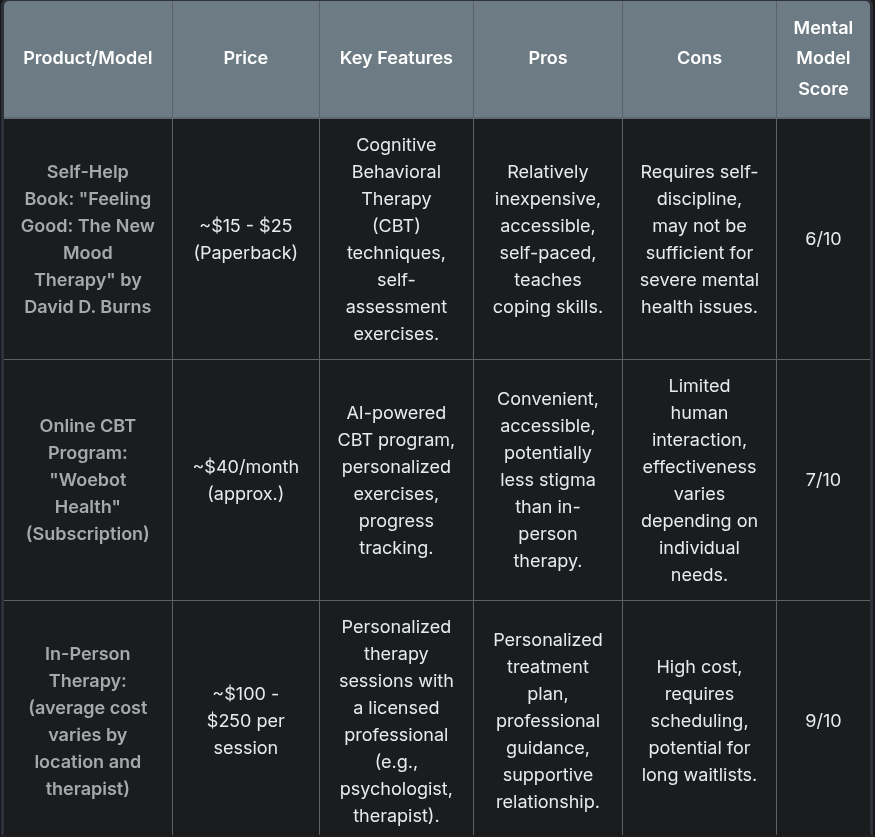
Product Comparison Table (extract):
Top Recommendation:
In-person therapy offers the highest potential ROI in terms of effectiveness and long-term mental well-being, despite its higher cost and time investment. The Opportunity Cost of not addressing potential mental health issues effectively far outweighs the financial investment in professional help, particularly if the problem is impacting daily life. The mental model score reflects this balance.
Action Steps:
Where to purchase: For in-person therapy, search for licensed therapists in your area through Psychology Today, your insurance provider’s network, or your primary care physician. For online options, visit the websites of BetterHelp or Woebot Health.
What to look for when buying: Thoroughly research therapists’ qualifications, specializations, and client reviews. For online platforms, check reviews and ensure the therapist is licensed in your state.
How to negotiate or get the best deal: Negotiate payment plans with therapists if needed. Explore your insurance coverage for mental health services. Look for introductory offers or discounts on online platforms.
Timeline for making the decision: Schedule a consultation with a therapist within the next 2 weeks to discuss your needs and assess the suitability of therapy.
Key Questions:
If your mental health doesn’t improve within a reasonable timeframe with self-help strategies, will you regret not seeking professional help sooner?
What are the potential long-term consequences of delaying professional intervention, if needed, compared to the short-term cost of therapy?
What level of improvement in your mental well-being would justify the cost and time investment of professional therapy?
The mentalmodelsapp platform suggests that instead of letting this decision paralyze us, we can apply a powerful analytical tool: the opportunity cost model. By using the app, you gain three key benefits that can help you navigate this difficult choice.
1. It Frames Your Decision in a Structured Way
The app helps you move beyond the emotional weight of the question and into a structured analysis. Instead of grappling with vague fears and desires, you’re prompted to consider the tangible and intangible costs of each option. What is the opportunity cost of not seeking help? It could be the loss of time, prolonged emotional distress, or missed opportunities for personal growth. Conversely, what is the opportunity cost of seeking help? This might include financial costs, time commitment, or the vulnerability of opening up to a professional. The app forces you to define and weigh these factors, turning a nebulous emotional conflict into a clear, comparative analysis.
2. It Provides an Objective Lens
Our decisions are often clouded by personal biases and wishful thinking. The mental models app acts as an objective third party, guiding you through a process that minimizes these biases. By using the opportunity cost model, you’re not just considering what feels right, but what the data—your own defined costs and benefits—actually suggests. This allows you to make a decision based on a more rational evaluation, rather than being swayed by the hope that things will magically get better without action.
3. It Empowers You to Make an Informed Choice
Ultimately, the goal of the mental models app is to empower you. The decision to seek help or to wait it out is deeply personal, and there is no single right answer for everyone. However, an informed decision is always better than a reactive one. The app doesn’t make the choice for you, but it gives you the tools to understand the full implications of each path. By using the opportunity cost model, you gain the clarity and confidence needed to make a choice that aligns with your long-term well-being.
Ready to move from hope to clarity? Apply the opportunity cost model to your own difficult choices and start making persistent decisions today.
Written for the Mental Models App by Hyper Lexia — may your decisions be as sharp as your curiosity.
Deciding who to date might feel like something best left to the heart—but what if you could bring clarity and structure to the process, without losing the romance?
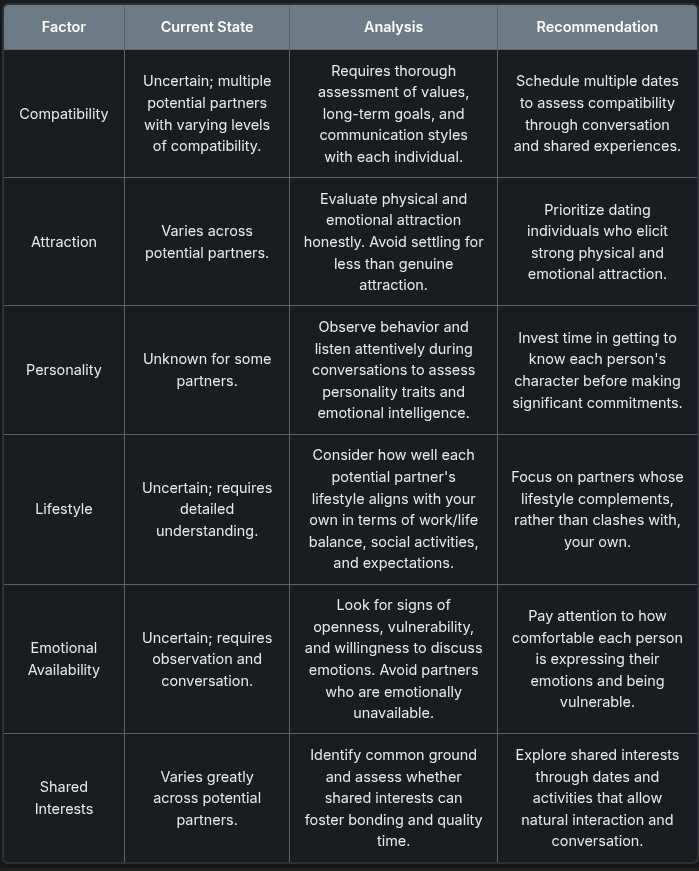
I submitted this question to my AI Mental Model Assistant: “Help me figure out who to date.” Rather than giving a generic answer, the assistant applied a powerful decision-making tool: Trade-Offs and Priorities Analysis.
This model is about making choices based on what matters most to you. It recognises that every decision involves compromise—so it helps you weigh your options systematically, according to your own values.
In this case, the assistant broke the decision down into six essential factors:
Compatibility
Attraction
Personality
Lifestyle
Emotional Availability
Shared Interests
By comparing potential partners across these dimensions, the app helps users see where each option aligns—or falls short. It doesn’t hand out a verdict; it illuminates the trade-offs so you can make a conscious choice, not just an impulsive one.
👇 Here’s the real analysis table generated by the assistant:
This is what it looks like to bring structured thinking to one of life’s most personal choices. Want to try it yourself?
👉 Visit mentalmodelsapp.com and submit your own dilemma—romantic or otherwise. You might be surprised by what you discover when you think in models.
Written for the Mental Models App by Hyper Lexia — may your decisions be as sharp as your curiosity.
Second-order thinking is about looking beyond the immediate, obvious consequences of a decision and considering the ripple effects – the consequences of the consequences, and even the underlying assumptions that lead us to those initial thoughts. It’s about asking “And then what?” repeatedly, and challenging the “taken-for-granted” beliefs (presuppositions) that often guide our first-order thinking. You can explore this concept further and apply it to your own decision-making using tools like the AI Assisted Decision Making app.
Let’s use the example of financing your studies:
First-Order Thinking:
You might initially think: “I need money for my studies. A student loan is available. Therefore, I will take a student loan.” This is a straightforward, immediate solution to an immediate problem. The presupposition here is often “student loans are a standard and necessary way to fund higher education.”
A second-order thinker would then ask: “And then what if I take a student loan?”
Consequence 1: I’ll have the funds to enroll in my desired modules and continue my degree.
And then what? I’ll be able to complete my degree, which could lead to better job prospects.
And then what? I might earn more money, but I’ll also have the burden of loan repayments.
And then what? Will the increased income truly offset the mental and financial stress of debt? What if job prospects aren’t as good as anticipated? What if my personal circumstances change?
Consequence 2 (uncovering a presupposition): Taking a loan means incurring debt.
And then what? This debt will accrue interest over time, potentially becoming a much larger sum than I initially borrowed.
And then what? This could impact my ability to save for other life goals (e.g., buying a home, starting a family, retirement).
And then what? My financial freedom in the future might be significantly constrained.
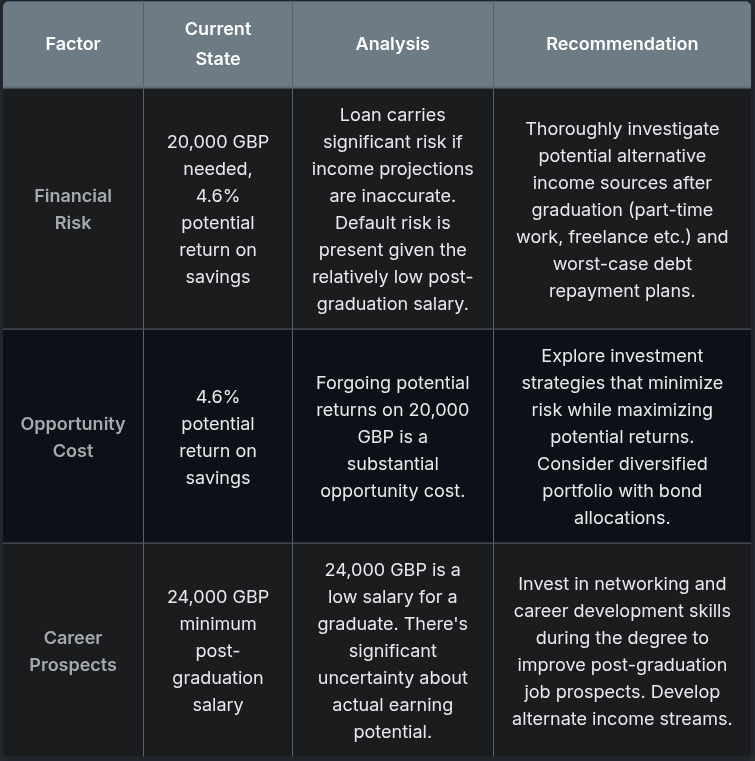
Here, the second-order thinking helps you challenge the initial presupposition that a student loan is the only or best path. By digging deeper, you might uncover a new line of thought: “What if I use (some of my) personal savings instead?” This leads to a different set of consequences and, potentially, a more favorable long-term outcome, even if it requires a different immediate approach.
The presupposition that “student loans are the default” or “I must take a loan to study” is examined and potentially overturned when you consider the deeper, long-term implications. You shift from simply reacting to the immediate problem to proactively shaping your future financial landscape.
Go Beyond the Obvious: Second-order thinking encourages you to move past the immediate solutions and explore the wider, often hidden, consequences of your decisions.
Challenge Your Assumptions (Presuppositions): Many decisions are based on underlying beliefs we don’t consciously examine. Second-order thinking helps you identify and question these “taken-for-granted” notions, opening up new possibilities.
Think “And Then What?”: This simple question is the core of second-order thinking, prompting you to trace the chain of effects and consider how a decision today might play out weeks, months, or even years down the line.
Written for the Mental Models App by Hyper Lexia — may your decisions be as sharp as your curiosity.
We’ve all faced it: a big decision with not enough data. Maybe you’re launching a new service, changing careers, or investing in a product—but the future feels foggy. That’s where the Margin of Safety mental model shines.
🧠 What Is the Margin of Safety Model?
Originally from engineering and investing, the Margin of Safety is a decision-making approach designed to protect you against the unknown. Rather than betting everything on what’s most likely to happen, it asks:
“What if I’m wrong?”
This model assumes that:
You don’t have all the facts.
The future is unpredictable.
Mistakes or surprises are more common than we think.
That’s not pessimism—it’s prudence.
💡 Why This Model Fits the Scenario
When you’re making a decision with incomplete information, optimization models like “best-case scenario” thinking can backfire. The Margin of Safety flips that by asking:
What’s the worst that could happen?
How can I protect myself from it?
Can I test this idea without committing fully?
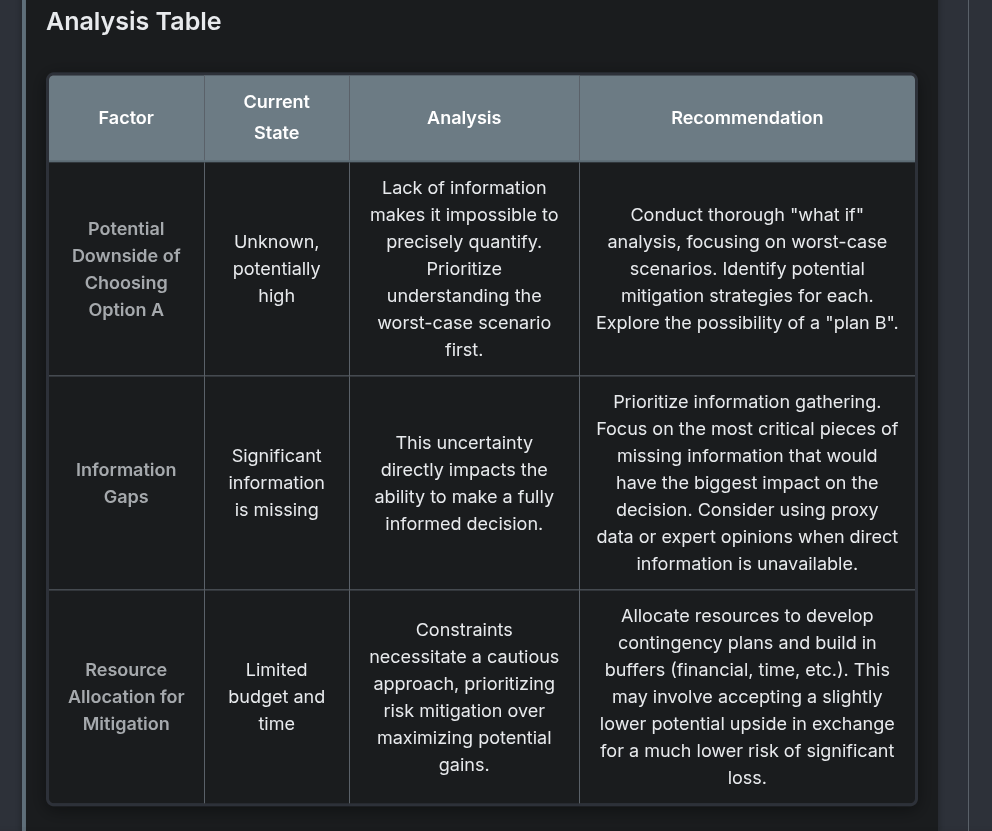
In a recent user case, my app recommended this model to guide a decision made under high uncertainty. The user didn’t have key data and was at risk of overcommitting. By applying the Margin of Safety model, they created:
A phased approach to reduce exposure
Conservative estimates to avoid overestimating upside
A backup plan in case things went south
✅ Key Takeaways for Better Decision-Making
Presume incomplete information. Don’t aim for perfect foresight—plan for imperfect conditions.
Build in buffers. Time, money, energy—give yourself wiggle room.
Act in stages. Test your ideas small before scaling up.
Think in terms of reversibility. Can you undo or adjust your choice later?
Here’s a table created with mentalmodelsapp.com that guides your path towards a potential solution:
🎯 Real-Life Example: Booking a Wedding Venue Without Knowing the Guest Count
Let’s say you’re planning a wedding, and you need to book the venue — but you’re not sure how many guests will attend. Invitations are out, RSVPs are slow, and you’re under pressure to make a deposit. Sound familiar?
Here’s how the Margin of Safety model applies:
Element
Application
Worst-case scenario
You overbook an expensive venue for 150 guests, but only 80 show up — wasted budget.
Conservative estimate
You plan for 100 attendees based on historical RSVP return rates (e.g., 60–70% typically attend).
Phased approach
Choose a venue that allows you to increase or decrease your headcount closer to the date.
Reversibility
Ask about refund policies or date changes. Negotiate terms that reduce non-refundable risks.
Buffer-building
Allocate 10–15% of your budget for last-minute changes, like renting extra tables or cutting catering.
Margin of Safety mindset: Instead of booking for the absolute maximum guest list (which feels “safe” emotionally), you book for the most probable number, plus a small buffer. You protect your budget and your peace of mind.
The power of the Margin of Safety is not in avoiding risk—but in managing it smartly.
💬 What About You?
Where in your life are you facing a decision without all the facts? Could you apply the Margin of Safety model to protect yourself from a worst-case scenario — maybe in your finances, career, relationships, or health?
Try asking:
What’s the cost of being wrong?
Can I test this idea in a smaller, safer way first?
What buffer would make this choice feel less risky?
Use the Mental Models App to walk through your own scenario and see how building in a margin could make all the difference.
Written for the Mental Models App by Hyper Lexia — may your decisions be as sharp as your curiosity.
Every choice you make silently turns down countless others. That’s the essence of opportunity cost—the hidden price of every “yes.”
🧠 What Is Opportunity Cost?
Opportunity cost is what you give up when you choose one option over another. It’s not always money—it could be time, energy, focus, or experiences.
Why It Matters
Opportunity cost is a powerful decision-making lens that helps you:
Surface invisible trade-offs
Avoid default or automatic decisions
Reduce FOMO and indecision
Clarify how you spend limited time and energy
The Five Assumptions Behind Opportunity Cost
Resources are limited (time, money, attention)
Options are mutually exclusive — choosing one means missing out on another
Benefits can be compared, even if qualitatively
You’re acting deliberately, not reactively
Your best option changes — reassess regularly
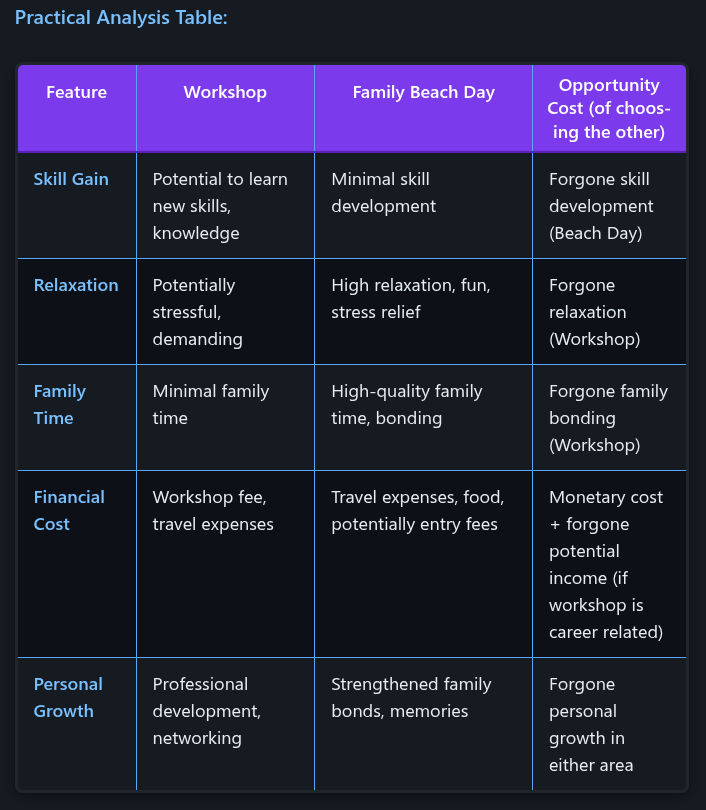
A Simple Example: The Weekend Choice
Scenario: You’re torn between…
🧑💼 Attending a Workshop: skills, networking, career growth
🏖️ Going to the Beach: rest, family bonding, memories
Ask yourself:
“If I choose the workshop, what do I give up? If I choose the beach, what am I forgoing?”
There’s no right answer—just a more aware one. This lens makes the consequences of your choice clearer.
Quick Tip: Shift Your Language
Instead of saying:
“I can’t afford it” or “I don’t have time”
Say:
“I’m choosing X instead of Y”
This small change:
Increases clarity
Builds self-awareness
Removes guilt
✅ Final Takeaway
Opportunity cost isn’t about perfection—it’s about conscious trade-offs. When you name what you’re giving up, you make better, more intentional decisions.
Want to think better and choose more wisely? Start with what you’re saying “no” to every time you say “yes.”
Here’s a table created with mentalmodelsapp.com that guides your path towards a potential solution:
Suddenly, decisions get clearer, faster, and far less guilt-ridden.
Written for the Mental Models App by Hyper Lexia — may your decisions be as sharp as your curiosity.
Welcome to Persistent Decisions, a space for refining our minds and making smarter choices. This first post, from my upcoming ebook, introduces mental models.
Mental models are essentially tools for the mind. They’re simplified representations of how the world works, transforming complexity into understandable chunks. Like a city map helps you navigate, mental models help us simplify, understand, and predict. They improve our thinking, leading to better decisions, problem-solving, and achieving meaningful goals.
Why Learn About Mental Models?
Mental models help you understand yourself, others, and the world. They lead to better decisions and improved lives and encourage clearer thinking for a more rational world.
I’ve also created an app, mentalmodelsapp.com, to help you apply these models and make persistent decisions.
Join me as we explore these powerful tools for a more intentional future.
 Persistent Decisions