The Margin of Safety Model
We’ve all faced it: a big decision with not enough data. Maybe you’re launching a new service, changing careers, or investing in a product—but the future feels foggy. That’s where the Margin of Safety mental model shines.
🧠 What Is the Margin of Safety Model?
Originally from engineering and investing, the Margin of Safety is a decision-making approach designed to protect you against the unknown. Rather than betting everything on what’s most likely to happen, it asks:
“What if I’m wrong?”
This model assumes that:
- You don’t have all the facts.
- The future is unpredictable.
- Mistakes or surprises are more common than we think.
That’s not pessimism—it’s prudence.
💡 Why This Model Fits the Scenario
When you’re making a decision with incomplete information, optimization models like “best-case scenario” thinking can backfire. The Margin of Safety flips that by asking:
- What’s the worst that could happen?
- How can I protect myself from it?
- Can I test this idea without committing fully?
In a recent user case, my app recommended this model to guide a decision made under high uncertainty. The user didn’t have key data and was at risk of overcommitting. By applying the Margin of Safety model, they created:
- A phased approach to reduce exposure
- Conservative estimates to avoid overestimating upside
- A backup plan in case things went south
✅ Key Takeaways for Better Decision-Making
- Presume incomplete information. Don’t aim for perfect foresight—plan for imperfect conditions.
- Build in buffers. Time, money, energy—give yourself wiggle room.
- Act in stages. Test your ideas small before scaling up.
- Think in terms of reversibility. Can you undo or adjust your choice later?
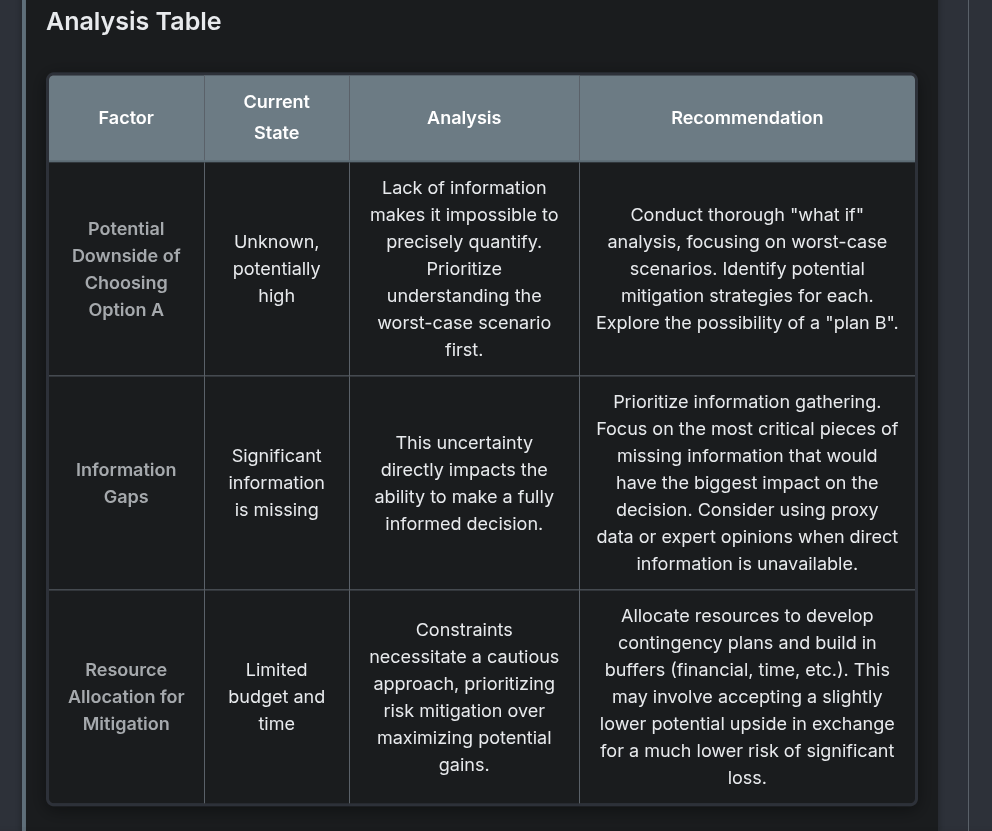
Here’s a table created with mentalmodelsapp.com that guides your path towards a potential solution:
🎯 Real-Life Example: Booking a Wedding Venue Without Knowing the Guest Count
Let’s say you’re planning a wedding, and you need to book the venue — but you’re not sure how many guests will attend. Invitations are out, RSVPs are slow, and you’re under pressure to make a deposit. Sound familiar?
Here’s how the Margin of Safety model applies:
| Element | Application |
|---|---|
| Worst-case scenario | You overbook an expensive venue for 150 guests, but only 80 show up — wasted budget. |
| Conservative estimate | You plan for 100 attendees based on historical RSVP return rates (e.g., 60–70% typically attend). |
| Phased approach | Choose a venue that allows you to increase or decrease your headcount closer to the date. |
| Reversibility | Ask about refund policies or date changes. Negotiate terms that reduce non-refundable risks. |
| Buffer-building | Allocate 10–15% of your budget for last-minute changes, like renting extra tables or cutting catering. |
Margin of Safety mindset:
Instead of booking for the absolute maximum guest list (which feels “safe” emotionally), you book for the most probable number, plus a small buffer. You protect your budget and your peace of mind.
The power of the Margin of Safety is not in avoiding risk—but in managing it smartly.
💬 What About You?
Where in your life are you facing a decision without all the facts?
Could you apply the Margin of Safety model to protect yourself from a worst-case scenario — maybe in your finances, career, relationships, or health?
Try asking:
- What’s the cost of being wrong?
- Can I test this idea in a smaller, safer way first?
- What buffer would make this choice feel less risky?
Use the Mental Models App to walk through your own scenario and see how building in a margin could make all the difference.
Written for the Mental Models App by Hyper Lexia — may your decisions be as sharp as your curiosity.
 Persistent Decisions